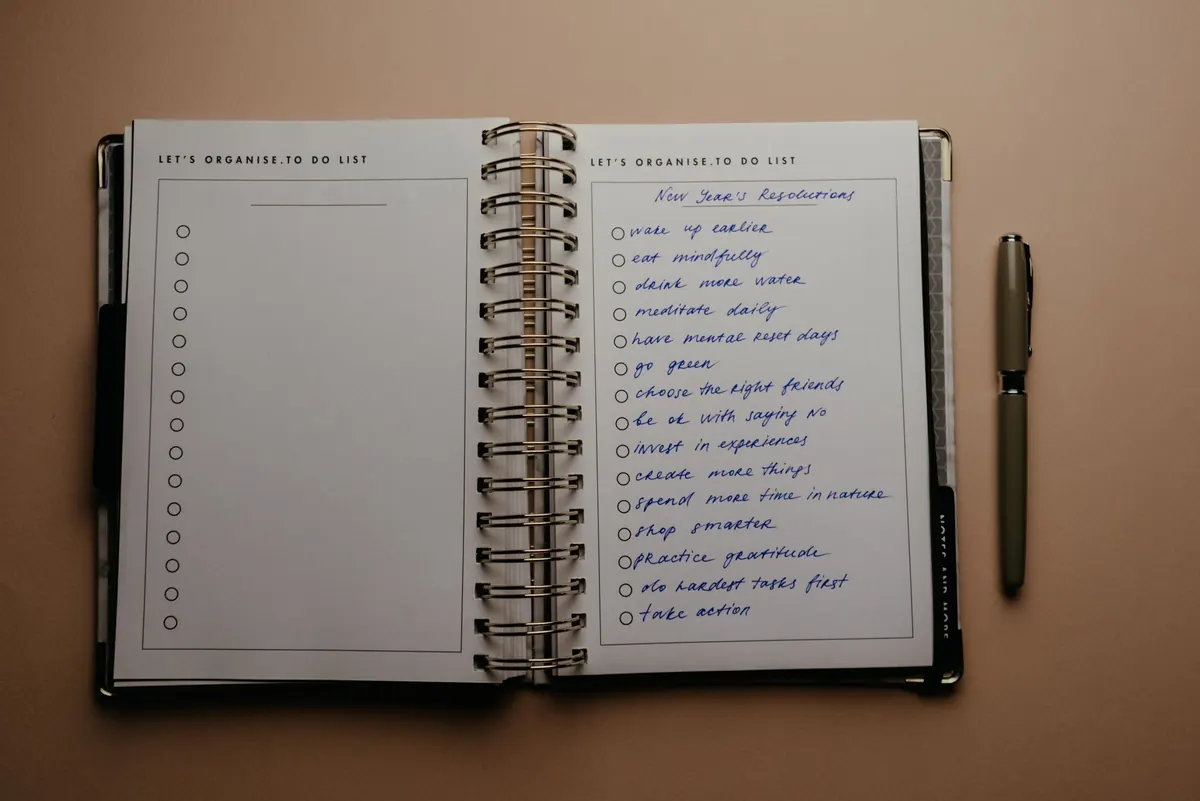
Motivation is a lovely thing on the days it turns up. It is a poor thing to build a habit on. Anyone who has journalled for more than a few months has a stretch of weeks where the notebook sat on the bedside table, untouched, quietly reproaching them. The people who carry on are rarely more disciplined than the rest of us. They have simply made a handful of small decisions in advance, before the enthusiasm ran out.
Lower the bar until it feels almost too easy
Most abandoned journals were not abandoned because the writer ran out of things to say. They were abandoned because the standard crept up too high. A page a day sounds modest until you have a deadline, a cold and a pile of washing-up — at which point it sounds like homework.
So set a minimum you could meet on your very worst day. Two sentences. Three bullet points. A single line naming the weather and your mood. What you are protecting is the act of turning up, not the quality of the prose. If your target is 750 words and you have eight minutes before the school run, you will skip it. If your target is one line, you almost certainly will not.
Write that minimum version on the inside cover of the notebook, so you never have to negotiate with yourself about it at ten past eleven at night. It is surprising how often the one line becomes five, but that is a bonus rather than the point.
Anchor it to something you already do
A new habit needs a trigger that already exists. Deciding to journal “at some point” gives you nothing to hang it on. Bolting it to something you do without thinking gives you a cue: the first coffee of the day, the moment you close your laptop, the ten minutes after you get into bed.
Pick one anchor and describe it precisely. “While the kettle boils, at the kitchen table” works far better than “in the mornings”, because it names a moment you cannot accidentally miss. If the kettle moment passes, you have another one after lunch.
Be careful with anchors you cannot control. “After the children are asleep” sounds sensible until the evening they are not. The best anchors are dull, daily and entirely yours.
Have a script ready for low-energy days
On flat days, the blank page is the problem — not you. Remove the decision about what to write by keeping a few formats you can use without thinking. Any of these will do:
- Three lines: what happened, how I felt, what I need tomorrow.
- Mood report: one sentence describing your day like a weather forecast. “Grey, with a chance of irritation by three.”
- Bullets only: the day in five fragments, no full sentences permitted.
- One word plus the date: enough to mark the day, and often enough to prompt more.
- The same question for a week: what did I avoid today? What was I looking forward to? What would I change?
Keep two or three of these on the first page of your notebook rather than trusting yourself to remember them. A prompt you have to think up is a prompt you will not use.
Decide in advance what counts as done
Vague standards are where habits go to die. Decide now: writing at 11.58pm counts. Backdating yesterday counts. Writing about the fact that you did not want to write counts. Half a page counts, and so does a single line in the margin.
Then add one rule that does most of the work: never miss twice. Missing a day is normal and harmless. Missing three in a row is how a practice quietly ends, because by then the gap has started to feel like evidence. If you miss Monday, Tuesday matters more than any other day that month.
Make the busy weeks easier on yourself
Busy weeks are not the exception; they are part of the pattern. Plan for them rather than being surprised by them.
- Keep the notebook where you actually sit, not in a drawer. A journal that lives out of sight gets written in about as often as a gym membership kept in a wallet.
- Keep a pen with it. More entries are lost to “no pen” than to any crisis of confidence.
- Carry something smaller during frantic periods — a pocket notebook or the notes app on your phone — and collect fragments: overheard lines, a worry, a list of what is due this week.
- Talk into your phone on a walk, then copy the useful bits across when you have five spare minutes.
- Swap your slot if the evening is collapsing. During a heavy month, ten minutes before work may be the only time you genuinely have.
- Set a smaller target for the week and say so out loud to yourself. “One line a day until Friday” is a plan; “back to normal soon” is not.
Plan your return before you need it
At some point you will stop for two weeks. When you come back, resist the urge to account for every missing day. Instead, turn to a fresh page, write “where I’ve been” at the top and summarise the gap in five bullets. Then carry on from today.
Backfilling is exhausting and rarely accurate. Nobody is marking this. If reading old entries makes you cringe, remember that the person who wrote them was working with less information than you have now — most of us would sound the same in hindsight.
Keep the thread, not the streak
Streaks suit some people and punish everyone else. A hundred-day run is a fine thing until day 101, when one missed evening can feel like a reason to stop altogether. A thread is more forgiving and more useful: you are collecting a record, and records have gaps.
Once a month, sit down with a cup of tea and read back over the last few weeks. Notice what keeps coming up, what you were worried about that never happened, what you keep saying you will start. Write one sentence about what you want to do differently next month, and change the format if it has stopped fitting your life.
Journalling is there to serve you, not to add another obligation to a full week. If, however, your writing keeps circling the same painful subject and it feels too heavy to carry alone, that is worth mentioning to your GP or a counsellor rather than pushing through on willpower. On ordinary days, a few honest lines on a Tuesday are enough — and they are the lines that keep the habit alive.
Photo: Polina ⠀ / Pexels